Research and Analysis
I’m pretty sure that going through a PhD program permanently scars your brain; after I graduated I haven’t been able to stop asking questions and researching answers for fun. Below are a few studies I’ve completed that apply machine learning and data science techniques to Christian texts.
A Survey of 175 Years of Southern Baptist Resolutions

Sometime in the fall of 2016 I got it into my head to study the resolutions of the Southern Baptist Convention, America’s largest Protestant, Christian organization. As a member of an SBC church and wanting to expand beyond my physics background, it seemed like a great idea. Four years, thousands of lines of code, and nearly 10000 words later I finally finished.
I’m incredibly grateful to the editors of Southeastern Theological Review for publishing this work and pray it will edify the body of Christ and provide context in confusing times. If you’re curious about how the focus of the SBC has changed over time, please read the article here. If you’re interested in the mathematical details, they’re available at this link.
TLDR:
In 175 years, the Southern Baptist Convention has changed considerably. Beginning as a missions organization, it has since grown into what is effectively the second largest Christian denomination in the United States. The yearly resolutions adopted by the SBC provide a means of understanding how the group’s focus and priorities have shifted, as they require a majority to be adopted and are written with the intent of public dissemination. In this analysis, all resolutions adopted by the SBC between 1845 and 2020 were collected, cleaned, and processed using data science techniques. Non-negative Matrix Factorization was then applied to identify topics in the documents, revealing several significant changes in how the language of the resolution has changed through the decades. Combined with select statements from the yearly proceedings, context for the shifts observed has been provided.
The resulting narrative is a compelling one: the SBC was originally founded as a missionary organization in order to make space for slaveholders to represent the Church abroad. In keeping with its missional goals, between 1845 and 1900 the SBC largely used the resolution to direct and support its missionary activities alongside managing administrative tasks. During this early period messengers mostly remained silent on other issues. As the organization grew and expanded three significant shifts occurred. First, between 1890 and 1940, there was a push to mechanize the SBC. This ultimately resulted in a functional move to a more representative form of governance and, through the creation of the ERLC, an institutional commitment to engage with broader moral and ethical issues. Second, around 1900, the SBC began to increasingly use its public platform to directly address social, cultural, and political issues, starting with a complete and total support for the prohibition of alcohol. Finally, following the Conservative Resurgence’s success in 1990, the SBC appears to largely have embraced unity in doctrine, grounding almost every moral position and statement present in the resolutions under the supreme authority of Scripture.
The people, preaching and priorities of Together for the Gospel
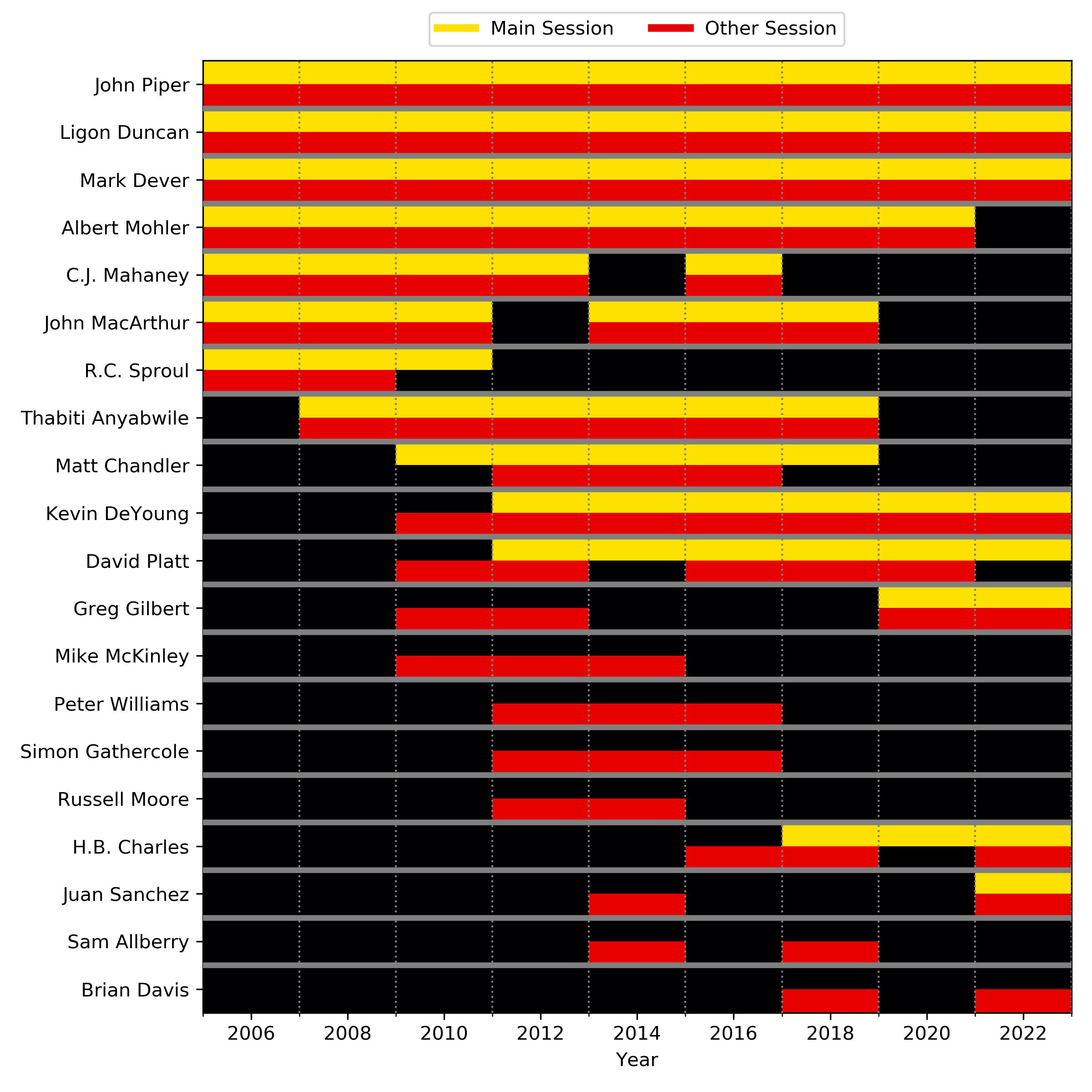
In 2022 for the first (and last time) I attended the Together for the Gospel (T4G) conference in Louisville, KY. The experience was surprisingly impactful - the sound of 12,000 men and women singing praise to Christ is humbling. The caliber of preaching was astounding. But most notable was the centrality of the Gospel and the modeling of healthy relationships among believers. Through the warmth and friendly banter displayed by the hosts on stage I walked away with a clearer picture of how preaching propagates the Gospel and was encouraged to see the fire of faith, present first in the apostles, still being passed on through faithful men today.
During the conference I made an offhand comment to my pastor that I could use a computer to collect all his sermons and, with a bit of machine learning, summarize everything he'd ever said from the pulpit. A few weeks after T4G ended, somewhat on a whim, I began to do just that for the conference; with most of the transcripts from past events available on YouTube, and the rest able to be created using AI, it was fairly straightforward to gather, organize, and summarize everything said at T4G over its 16 year run.
I sought to better understand what Together for the Gospel has stood for over the years. Who was involved? What did they preach? Did cultural forces shape the conference? With my background in scientific research this became a year-long study to use machine learning to summarize nine conferences' worth of sermons and discussions and to place this data in the context of current trends in the Evangelical Church. In learning about the history of the conference, however, I soon discovered just how close I'd been to this movement without realizing the value of what, by the grace of God, I'd stumbled into.
To begin with, I learned that I am a byproduct of the Young Restless Reformed movement. Finding a church composed of my peers in college I embraced reformed evangelicalism, falling in love with its focus on doctrine and missional living. My friends and I read many books from YRR writers: David Platt's Radical, Matt Chandler's Explicit Gospel, much of John Piper's work and, of course, Mark Dever's 9 Marks of a Healthy Church. Our theology was thoroughly reformed, our ecclesiology biblical, and our focus missional.
I am deeply indbeted to the people, preaching, and priorities of T4G. Click the link to download the full article on the conference, speakers, and topics.
A machine-augmented survey of the SBC's convention sermons and presidential addresses

Sometimes research leads to great insights, and sometimes it’s just… ok. That’s what this is; following up on my study of the SBC’s resolutions, I decided to also track how the sermons and presidential addresses at the yearly meeting have changed over time. The Southern Baptist Historical Library and Archives has digitized a significant amount of material. With a bit of help from open source image processing software it seemed like a straightforward way to see what sort of topics leadership in the SBC has focused on. Unfortunately the small number of documents meant that tracking trends proved more difficult than I had hoped.
Here are the results of my study. If you’re curious about how the focus of the SBC’s leadership has changed over time, click the link to read the article.